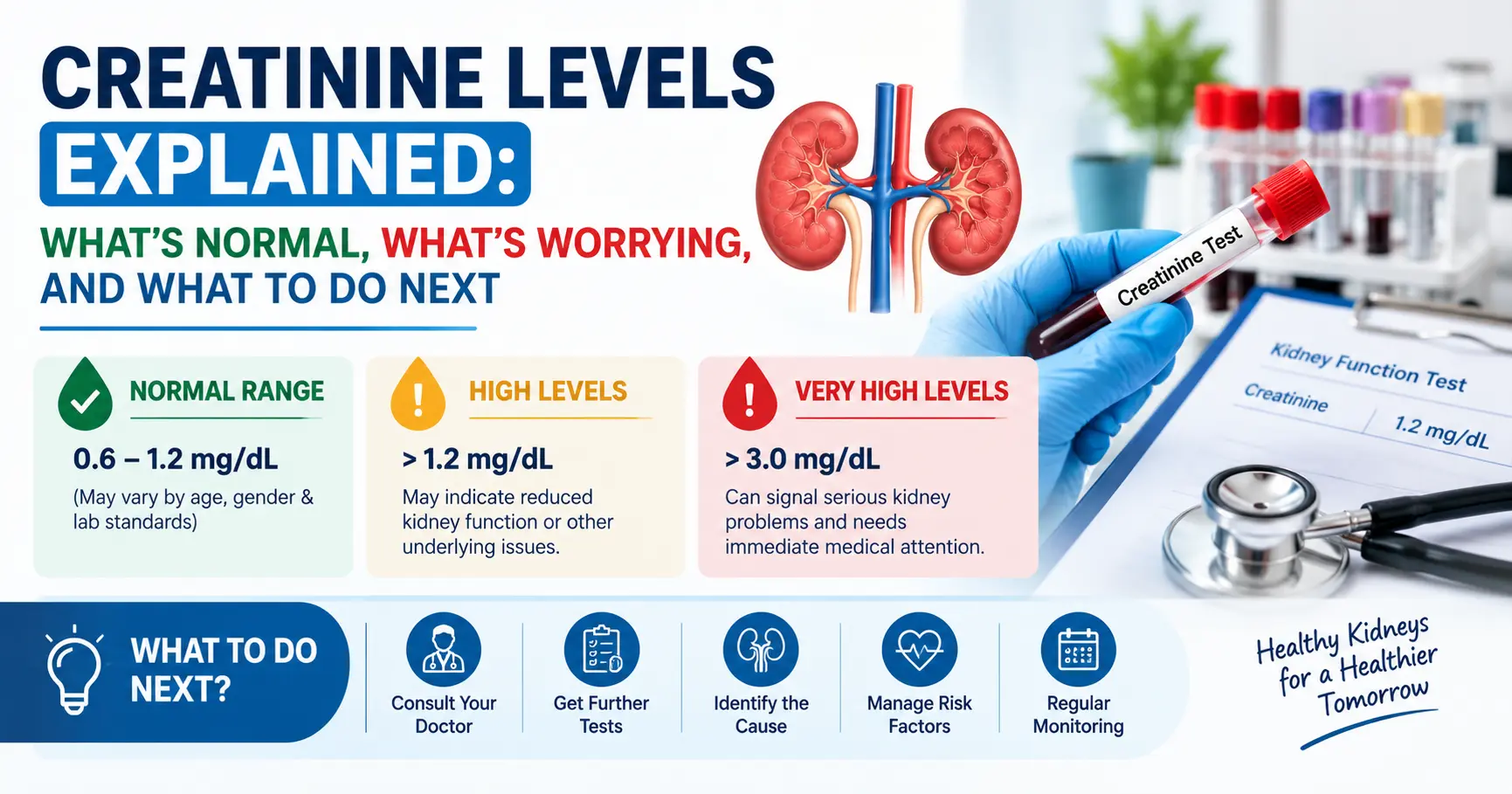
If you've just received a lab report showing "creatinine" flagged in red or bold, you're probably here because you searched the term in a slight panic. That's completely understandable — but a single creatinine number, on its own, rarely tells the full story. Here's what creatinine actually measures, what counts as normal, what a high result might mean, and exactly what to do next.
What Is Creatinine, and Why Does It Matter?
Creatinine is a waste product produced by your muscles at a fairly constant rate as part of normal muscle activity. Healthy kidneys filter creatinine out of the blood continuously and remove it through urine. Because the rate of creatinine production stays fairly steady, doctors use its level in your blood as a practical, reliable way to estimate how well your kidneys are filtering — this is why it's one of the most commonly ordered blood tests in routine health checkups.
What Counts as a Normal Creatinine Level?
Normal ranges vary slightly between labs, but as a general reference:
- Adult men: approximately 0.7 to 1.3 mg/dL
- Adult women: approximately 0.6 to 1.1 mg/dL
These ranges differ by sex mainly because men typically have more muscle mass, which produces more creatinine as a natural byproduct — it isn't a reflection of kidney health differing between men and women. Ranges can also vary slightly with age, body size, and muscle mass, and different laboratories sometimes use slightly different reference ranges on their reports, so always check the "normal range" column printed alongside your specific result.
Why Creatinine Alone Doesn't Tell the Whole Story
A single creatinine number is a useful starting point, but doctors rarely rely on it in isolation. That's because creatinine levels are affected by factors that have nothing to do with kidney health, including:
- Muscle mass — a very muscular person may have a naturally higher creatinine level with perfectly healthy kidneys
- Recent intense exercise or muscle breakdown
- Dehydration, which can temporarily raise the reading
- Certain medications and high protein intake shortly before the test
This is why your doctor usually looks at creatinine alongside eGFR (estimated Glomerular Filtration Rate) — a calculation that factors in your creatinine level along with age, sex, and sometimes body size to give a more accurate picture of actual kidney function. A single mildly elevated creatinine reading, especially after dehydration or intense exercise, is not automatically a diagnosis of kidney disease.
What Might Cause High Creatinine?
Elevated creatinine can result from a wide range of causes, from temporary and harmless to something that needs prompt medical attention:
- Temporary/reversible causes: dehydration, a recent high-protein meal, intense exercise shortly before the test, certain supplements, or some medications
- Kidney-related causes: chronic kidney disease, acute kidney injury, urinary tract obstruction, or kidney infections
- Other medical conditions: uncontrolled diabetes, high blood pressure, heart failure, or certain autoimmune conditions that affect the kidneys over time
Because the list of possible causes is this broad, a raised creatinine result is a signal to investigate further — not a diagnosis by itself.
What to Do If Your Creatinine Is High
- Don't panic over a single number. One test result, especially if it's only mildly elevated, is a starting point for further evaluation, not a final verdict.
- Repeat the test if advised. Doctors often recommend repeating the test after ensuring proper hydration and avoiding strenuous exercise beforehand, since these can temporarily skew results.
- Ask for your eGFR value. This gives a clearer picture of kidney function than creatinine alone.
- Share your full context with your doctor — recent illness, medications, supplements, hydration status, and exercise habits all help interpret the result correctly.
- See a nephrologist if levels stay elevated across repeat tests, or if your doctor recommends further evaluation such as urine tests or a kidney ultrasound.
When a High Creatinine Result Needs Prompt Attention
While most mildly elevated results simply warrant a repeat test and further evaluation, seek medical attention promptly if a high creatinine reading is accompanied by:
- Significantly reduced urine output
- Swelling in the legs, ankles, or around the eyes
- Persistent nausea, vomiting, or confusion
- Shortness of breath
These combinations can indicate a more acute kidney problem that shouldn't wait for a routine follow-up appointment.
Final Thoughts
A creatinine test is one of the simplest, most informative windows into kidney health available — but like most single lab values, it's meant to be interpreted in context, not read in isolation. If your report shows a number outside the normal range, the right next step is a conversation with your doctor or a nephrologist, not a diagnosis drawn from a search engine.
If you've recently received a lab report with an abnormal creatinine result and would like it properly evaluated, our nephrology team can review your report, order any necessary follow-up tests, and help you understand exactly what it means for you.
This article is for general awareness only and does not replace professional medical advice. Lab reference ranges can vary between laboratories — always interpret your results with guidance from a qualified doctor.
Concerned about your kidney health?
Book a consultation with our nephrology team. A simple visit and routine tests are all it takes to know where you stand.
Book a consultation →