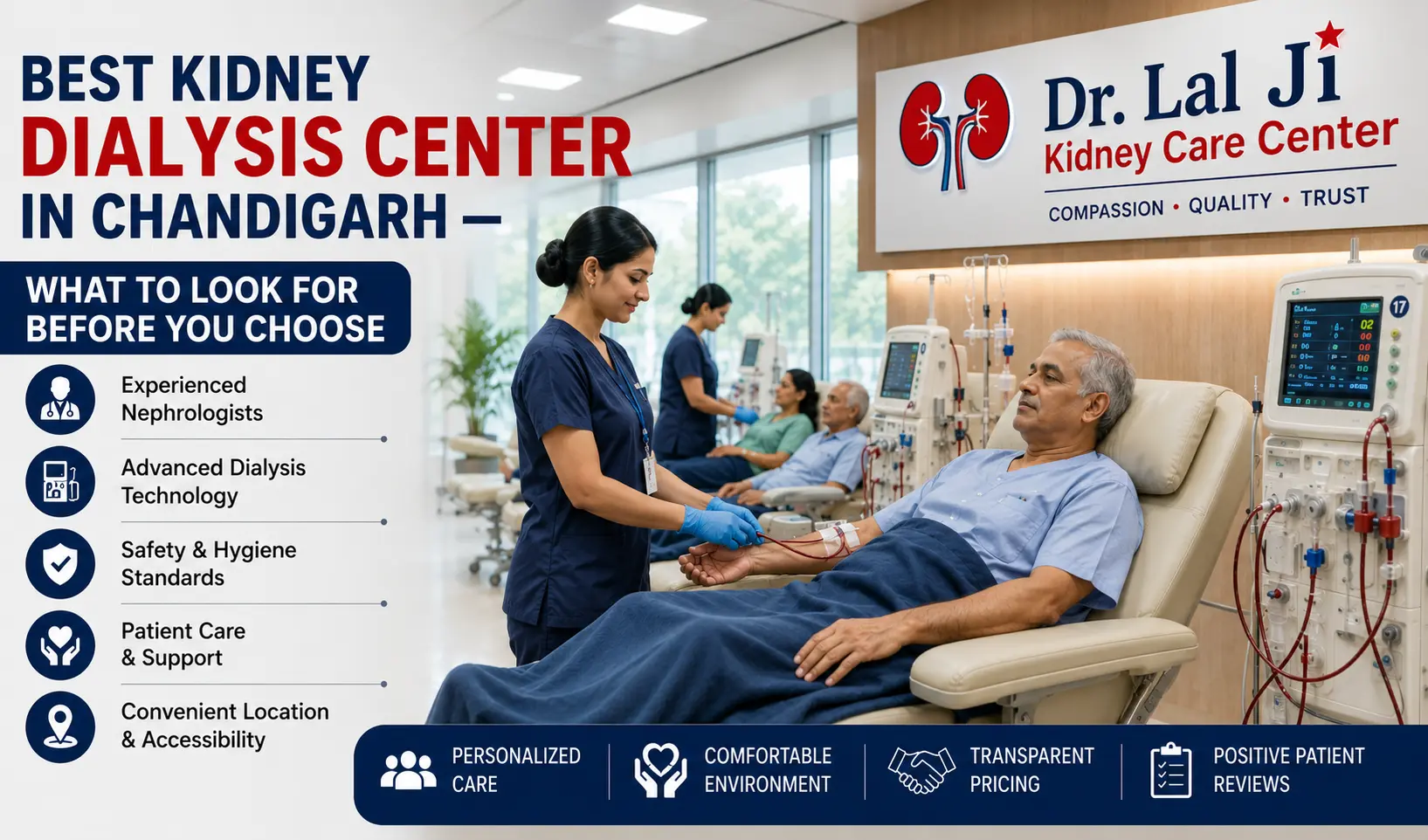
Choosing a dialysis center isn't like choosing any other healthcare provider — for most patients, it becomes a two-to-three-times-a-week relationship that lasts years. The right center can mean fewer complications, faster emergency response, and genuine peace of mind. The wrong one can mean recurring infections, inconsistent care, or being turned away when you need help most. Here's exactly what to check before you commit.
Why This Decision Deserves More Than a Quick Google Search
Unlike a one-time surgery or a single consultation, dialysis is ongoing — often for life, or until a transplant becomes possible. That makes the quality, consistency, and safety standards of your chosen center one of the most important healthcare decisions a kidney patient in Chandigarh will make. A short checklist-based visit before you decide can save years of frustration later.
1. RO Water Quality — The Most Overlooked Safety Factor
Every hemodialysis session passes large volumes of purified water through your bloodstream — far more than you'd ever drink directly. If the Reverse Osmosis (RO) water isn't tested and maintained to strict purity standards, contaminants can enter the blood directly, bypassing your gut's natural filtering. Ask any dialysis center in Chandigarh you're considering:
- How often is RO water quality tested, and by whom?
- Are microbiological and endotoxin levels checked regularly, not just chemical purity?
- Can they show you recent water testing records if asked?
A center that answers confidently and specifically — not vaguely — is one that takes this seriously.
2. Infection Control Protocols
Dialysis patients are more vulnerable to infections, both from the access site (AVF, permacath, or IJC) and from the shared clinical environment. A trustworthy center should have visible, non-negotiable protocols:
- Separate isolation stations or wards for seropositive patients (Hepatitis B, Hepatitis C, HIV)
- Single-use dialyzers and tubing — never reprocessed to cut costs
- Strict hand hygiene and access-site care between every single patient
- Visibly clean, well-maintained dialysis floors and equipment
What to watch for: if a center is unwilling to explain its infection-control practices clearly, or seems to treat the question as unusual, that itself is a red flag.
3. Doctor Availability — Not Just Technician Supervision
Dialysis is a medical procedure, not a mechanical one. Ask whether a qualified nephrologist is actually present or reachable during sessions — not just trained technicians running the machines. Specifically:
- Is a nephrologist available on-site, or only reachable by phone for emergencies?
- How quickly can a doctor respond if a patient has a reaction, a cramp, a blood pressure drop, or a complication mid-session?
- Is there a dedicated emergency room for kidney-related crises, separate from general hospital emergencies?
4. Machine Count and Waiting Times
A center with too few dialysis machines for its patient load leads to rushed sessions, inconvenient odd-hour slots, and hurried care. Before committing, ask:
- How many dialysis machines are currently in operation?
- What is the average waiting time to get a regular weekly slot?
- Is there flexibility for late arrivals, missed sessions, or emergency walk-ins?
A center that can accommodate you without long waitlists is one built to actually serve its patient volume, not just advertise capacity it doesn't have.
5. Emergency Readiness — Ask Before You Need It
The best time to check a center's emergency capability is before an emergency happens, not during one. Confirm:
- Is emergency dialysis genuinely available 24×7, or only during clinic hours?
- Is there ICU-level monitoring for patients with dangerous complications like high potassium or fluid overload?
- Can they manage an infected or malfunctioning access site as a same-visit emergency, rather than referring you elsewhere?
6. Cost Transparency and Insurance Support
Dialysis costs add up quickly, and hidden charges make an already stressful situation worse. A trustworthy center should be upfront about:
- Per-session costs, and what's included versus billed separately
- Whether they're empanelled under government schemes like Ayushman Bharat (PM-JAY), which can substantially reduce out-of-pocket costs for eligible patients
- Package options for regular, long-term dialysis patients
7. Accreditation and Certifications
Look for recognized quality markers rather than taking claims at face value — NABH accreditation, ISO 9001:2015 certification, and empanelment under Ayushman Bharat PM-JAY are all signals that a center has been independently evaluated against defined healthcare standards, not just self-certified.
A Quick Checklist Before You Decide
- ✔ RO water tested regularly, records available on request
- ✔ Clear infection-control protocols, including seropositive isolation
- ✔ Nephrologist genuinely available, not just technicians
- ✔ Enough machines to avoid long waits or rushed sessions
- ✔ True 24×7 emergency dialysis capability
- ✔ Transparent costs and insurance/PM-JAY support
- ✔ Recognized accreditation (NABH, ISO, government empanelment)
Final Thoughts
Dialysis is a long-term commitment between you and your care team — it deserves the same scrutiny you'd give any major, recurring healthcare decision. Don't hesitate to visit in person, ask direct questions, and request to see the dialysis floor before enrolling. A center confident in its standards will welcome those questions, not deflect them.
At Dr. Lal Ji Kidney Care Center in Khuda Lahora, Chandigarh, we're NABH accredited, ISO 9001:2015 certified, and empanelled under Ayushman Bharat (PM-JAY) — with 24×7 emergency dialysis, dedicated seropositive isolation, and a nephrologist-led care team. If you're evaluating dialysis centers in Chandigarh, we'd welcome the chance to answer these exact questions in person.
This article is for general awareness only and does not replace professional medical advice. Every patient's situation is different — please consult a qualified nephrologist to determine the right dialysis care plan for you.
Concerned about your kidney health?
Book a consultation with our nephrology team. A simple visit and routine tests are all it takes to know where you stand.
Book a consultation →