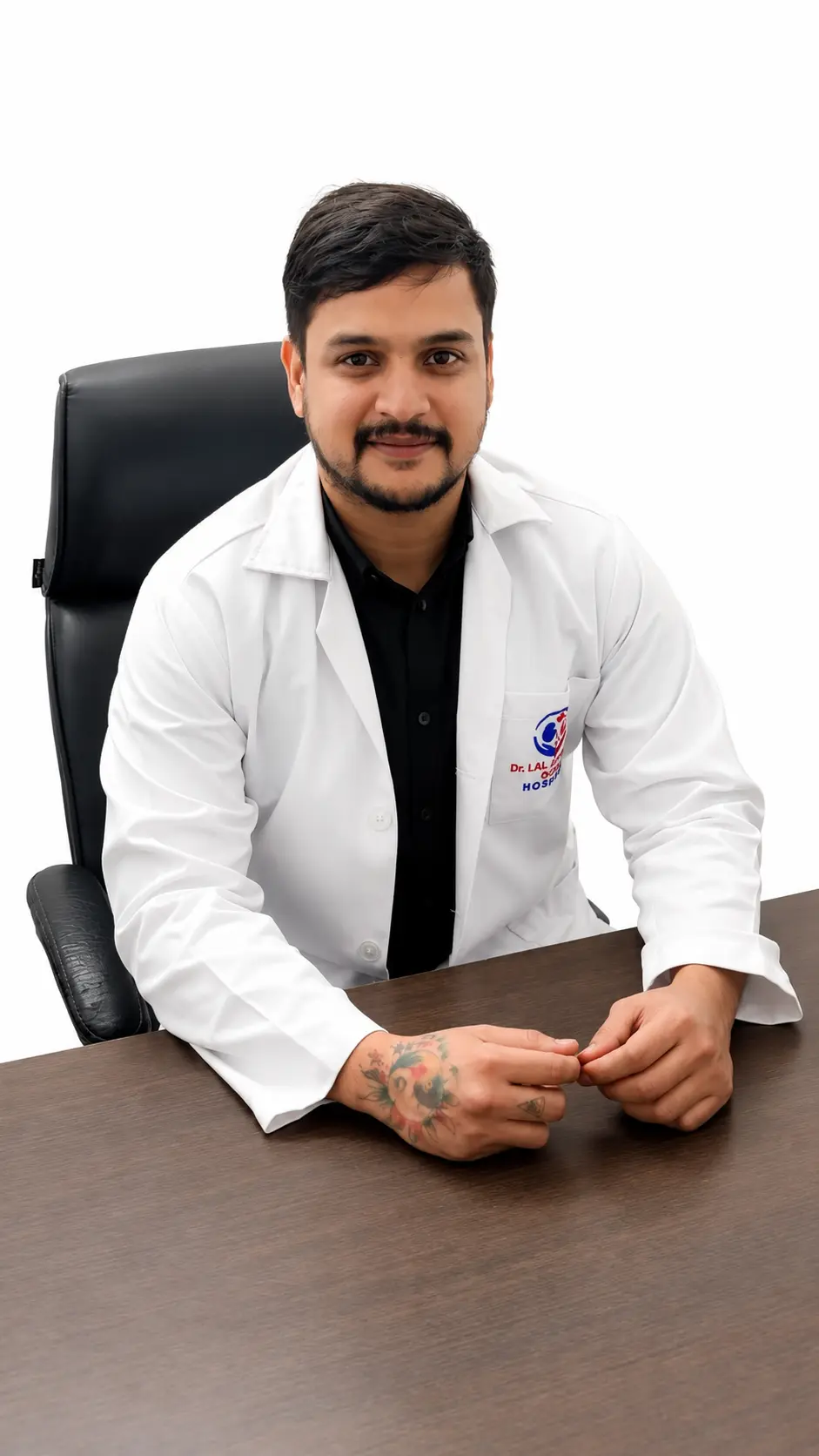
Dr. Sairam Mata
Consultant Anaesthesia & Intensivist | Medical Superintendent
MBBS, MD (Anaesthesiology) - PGIMER Chandigarh
Dr. Sairam Mata is a dedicated Anaesthesiologist and Critical Care Specialist with expertise in perioperative medicine, airway management, intensive care, trauma resuscitation, and management of critically ill patients. He completed his MBBS and MD (Anaesthesiology) from the prestigious Postgraduate Institute of Medical Education and Research (PGIMER), Chandigarh, one of India's leading institutes for medical education and advanced patient care.
As a Consultant Anaesthesiologist and Intensivist, Dr. Mata is actively involved in providing safe anaesthesia services for a wide range of surgical procedures and delivering evidence-based critical care management in ICU settings. His clinical interests include hemodynamic monitoring, ventilator management, sepsis care, perioperative optimization, and emergency critical care.
In his role as Medical Superintendent, he oversees clinical governance, quality improvement initiatives, patient safety protocols, infection control practices, and hospital administration, ensuring the highest standards of healthcare delivery.
Professional Philosophy: "Committed to delivering safe, compassionate, and evidence-based care while ensuring excellence in critical care services and hospital quality standards."
As a Consultant Anaesthesiologist and Intensivist, Dr. Mata is actively involved in providing safe anaesthesia services for a wide range of surgical procedures and delivering evidence-based critical care management in ICU settings. His clinical interests include hemodynamic monitoring, ventilator management, sepsis care, perioperative optimization, and emergency critical care.
In his role as Medical Superintendent, he oversees clinical governance, quality improvement initiatives, patient safety protocols, infection control practices, and hospital administration, ensuring the highest standards of healthcare delivery.
Professional Philosophy: "Committed to delivering safe, compassionate, and evidence-based care while ensuring excellence in critical care services and hospital quality standards."
Frequently asked
Questions patients ask.
What does an anaesthesiologist do?
An anaesthesiologist makes sure you stay safe, pain-free, and comfortable during surgery. We monitor your breathing, heart, and blood pressure throughout the procedure, choose the right type of anaesthesia for you, and manage critical care if you are in the ICU. We are the "behind the scenes" doctors who keep you stable during surgery.
What is the difference between general and regional anaesthesia?
General anaesthesia puts you into a deep controlled sleep for the entire surgery. Regional anaesthesia (like spinal or epidural) numbs only the part of the body being operated on, while you stay awake or lightly sedated. We choose between them based on the type of surgery, your health, and your preference.
Will I feel any pain during surgery under anaesthesia?
No. With either general or regional anaesthesia, you will not feel pain during the surgery. Our job is to keep you completely comfortable. After the surgery, we use pain-relief plans so that recovery is as smooth and pain-free as possible.
Is anaesthesia safe?
Modern anaesthesia is very safe — far safer than it was a few decades ago. We do a complete pre-anaesthesia check (heart, lungs, blood tests, medical history) before any procedure to identify and manage risks in advance. Serious complications are rare, especially in healthy patients.
Why do I need to fast before anaesthesia?
Fasting prevents food or liquid from accidentally entering the lungs while you are under anaesthesia, which can cause serious lung problems. Usually we ask for 6 hours fasting for solid food and 2 hours for clear fluids. The exact instructions are given to you before surgery.
How long does it take to wake up after anaesthesia?
Most patients are awake and responding within 15 to 30 minutes after general anaesthesia ends. You will feel drowsy for a few hours, and full alertness usually returns by the next day. We keep you under close observation in the recovery area until you are fully stable.
What is critical care or ICU treatment?
The Intensive Care Unit (ICU) is a specialized area for patients who are very seriously ill and need continuous monitoring of their breathing, heart, blood pressure, and other vital functions. ICU teams provide round-the-clock care with advanced equipment to support recovery from severe illness.
When does a patient need to be moved to the ICU?
A patient needs ICU care when they have unstable vital signs, need help breathing, have severe infection (sepsis), suffer major trauma, or need close monitoring after a complex surgery. The goal is to support the body while the underlying problem is being treated.
What is mechanical ventilation?
Mechanical ventilation is a machine-supported way of breathing for patients whose lungs cannot do the job on their own. A tube is placed in the airway, and a ventilator pushes oxygen in and out. It is a temporary support — the goal is always to return the patient to natural breathing as soon as possible.
Can dialysis patients safely receive anaesthesia?
Yes — with proper planning. We coordinate closely with the nephrologist to schedule dialysis appropriately before and after surgery, adjust medicines, and choose anaesthesia that is gentle on the kidneys. Dialysis patients undergo many procedures safely every day with the right team approach.
People also ask
Other questions frequently searched.
What are the side effects of anaesthesia?
Common, short-term side effects include nausea, sore throat (from the breathing tube), shivering, and tiredness for a day or two. Serious side effects are rare. We screen every patient beforehand and personalize the anaesthesia plan to minimize even minor side effects.
How long does anaesthesia last after surgery?
The active anaesthesia wears off in 30 to 90 minutes after surgery ends, but you may feel drowsy or "off" for 12 to 24 hours. For regional anaesthesia like spinal, full sensation in legs usually returns within 4 to 6 hours. Driving and major decisions should be avoided for 24 hours.
Is general anaesthesia dangerous for elderly patients?
It is not automatically dangerous, but elderly patients do need a more careful pre-anaesthesia assessment. Heart, lung, and kidney function are checked, medications are reviewed, and the anaesthesia plan is tailored. With the right precautions, elderly patients undergo major surgery safely every day.
Can someone wake up during surgery under anaesthesia?
This is extremely rare with modern monitoring. We continuously track depth of anaesthesia and vital signs throughout the procedure, adjusting medicines in real time. The fear of "waking up" is much more common than the actual event, which occurs in less than 1 in 1000 cases.
How long does an ICU stay usually last?
It depends entirely on the underlying problem — a few hours for post-surgery monitoring, a few days for serious infections, or a few weeks for severe trauma or multi-organ involvement. The aim is always to move the patient to a regular ward as soon as it is medically safe.
How much does ICU treatment cost per day?
ICU charges vary based on the level of monitoring, ventilator use, and the medicines required. At our centre we follow transparent pricing, and Ayushman Bharat or insurance cover applies where eligible. The billing desk explains every charge clearly to the family.
Can family members visit a patient in the ICU?
Yes — supervised visits are allowed during set hours. We follow strict infection-control protocols, so visitors may be asked to wear a gown, mask, or use hand sanitizer. Updates about the patient are shared regularly with the family by the treating team.
What does it mean when a patient is on a ventilator?
It means the patient needs machine support to breathe — either because their own lungs are too weak (severe pneumonia, COVID, etc.), or to give the body rest while a serious illness is treated. Being on a ventilator does not mean recovery is impossible; many patients are weaned off successfully.
Is spinal anaesthesia better than general anaesthesia?
Neither is universally "better" — it depends on the surgery, the patient, and the situation. Spinal is great for lower-body surgeries (Caesarean section, joint replacement, prostate) because it has fewer side effects and faster recovery. General is needed for longer or upper-body surgeries.
How do anaesthesiologists keep patients safe during surgery?
We continuously monitor heart rate, blood pressure, oxygen levels, breathing, and depth of anaesthesia using modern monitors. Drugs and fluids are adjusted moment to moment. A trained anaesthesia team stays with you from the moment surgery starts until you are fully stable in recovery.